
Minimum Housing Standards in Queensland: What Onsite Managers Must Check in Every Letting Pool Unit
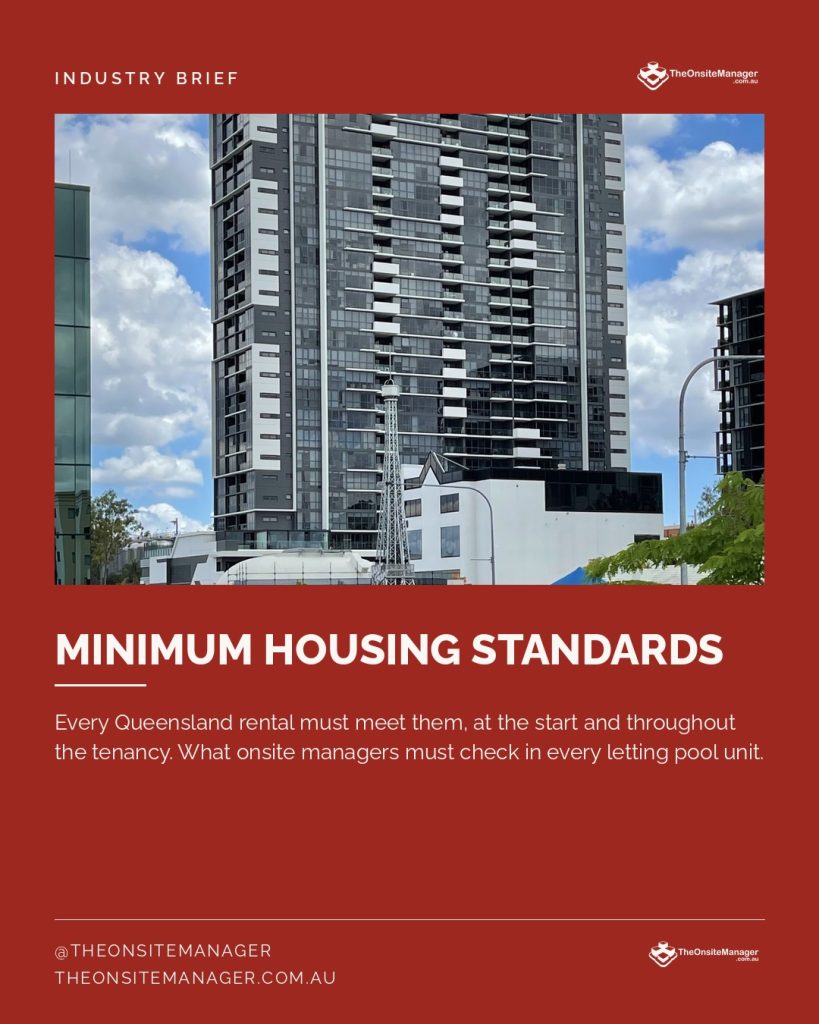
Every Queensland rental now has to meet the prescribed minimum housing standards, at the start of the tenancy and for as long as it lasts. The standards applied to new tenancies from 1 September 2023 and to all remaining tenancies from 1 September 2024. For onsite managers running a letting pool, they turn routine repair requests into compliance obligations. Here's what the law says and how to stay on the right side of it.
Where the standards come from
The Residential Tenancies and Rooming Accommodation Act 2008 (Qld) lets a regulation prescribe minimum housing standards (s 17A). Since 1 September 2025 they sit in Schedule 6 of the Residential Tenancies and Rooming Accommodation Regulation 2025 (s 18), which replaced the expired 2009 Regulation. At the start of a tenancy the lessor must ensure the premises and inclusions comply (s 185(2)(e)), and while the tenancy continues the lessor must keep them compliant (s 185(3)(e)). For this section, "premises" includes any common area available for use by the tenant with the premises (s 185(5)). Holiday lettings are outside the Act (s 31), so the standards bite on the permanent side of your letting pool.
The nine standards in Schedule 6
- Weatherproof, structurally sound and in good repair: roofs and windows must keep rain out, and floors, walls, ceilings, decks and stairs must not be likely to collapse from rot or defects or be affected by significant dampness.
- Fixtures and fittings, including electrical appliances, in good repair and not likely to injure anyone in ordinary use. Leaking taps and showerheads are the Regulation's own examples.
- A functioning lock or latch on every external window and door that someone outside could reach without a ladder.
- Free of vermin, damp and mould, unless the tenant caused it, for example by not using an installed exhaust fan.
- Privacy coverings such as blinds, curtains, tinting or frosting on windows in rooms where privacy is expected, like bedrooms, unless a fence, hedge, tree or other feature blocks the line of sight.
- Adequate plumbing and drainage for the number of occupants, and a connection to hot and cold water suitable for drinking.
- Private bathroom and toilet facilities, with each toilet flushing, refilling and connected to a sewer, septic or other waste system.
- A functioning cooktop, if a kitchen is included.
- The fixtures needed for a functional laundry, if a laundry is included. Whitegoods aren't required.
Breaches are emergency repairs
Works needed for premises or inclusions to comply with the minimum housing standards are emergency repairs (s 214(2)). Tenants report them to the nominated repairer or the lessor (ss 216, 217). If repairs aren't made within a reasonable time, a tenant can arrange a suitably qualified person, up to 4 weeks' rent, and seek reimbursement (ss 218, 219). The lessor's agent may arrange emergency repairs up to the same 4-week limit and deduct the cost from rent before paying the owner, telling the owner as soon as practicable (s 219A).
QCAT repair orders
A tenant can apply to QCAT for a repair order (s 221). QCAT can set deadlines, allow reduced rent, award compensation for loss of amenity, and, if the premises are vacant, order that they not be let until repairs are done (s 221A). A repair order doesn't end with the tenancy (s 221A(5)), and contravening one carries up to 50 penalty units (s 221C).
The body corporate overlap
The RTA notes that a rental in a body corporate must comply with both the minimum housing standards and the by-laws, and that some repairs needed to meet the standards may be the body corporate's responsibility, for example where the defect is in common property. Raise these with the committee or body corporate manager in writing straight away, keep the owner and tenant informed, and keep records.
A checklist for onsite managers
- Inspect every letting pool unit against all nine standards before each new tenancy, and record it in the entry condition report.
- Test window and door locks, blinds, taps, toilets and the cooktop at every routine inspection.
- Treat mould, leaks and broken locks as emergency repairs, not routine jobs.
- Keep your nominated repairer details current in every agreement.
- Get owners' written instructions on spending up to the emergency repair limit.
- Escalate common property defects to the body corporate in writing, with photos and dates.
👉 Onsite managers: join TheOnsiteManager and operate as a legally authorised agent of TheOnsiteManager: https://www.theonsitemanager.com.au/join
Marketplace & industry hub: https://www.theonsitemanager.com.au
Sources: Residential Tenancies and Rooming Accommodation Act 2008 (Qld) ss 17A, 185, 214, 216-219A, 221-221C (legislation.qld.gov.au, current version); Residential Tenancies and Rooming Accommodation Regulation 2025 (Qld) s 18 and Schedule 6; Residential Tenancies Authority, "Minimum housing standards" (rta.qld.gov.au/during-a-tenancy/minimum-housing-standards).
General information only, not legal advice. What applies depends on each lot, its tenancy agreement and the scheme's by-laws. Check with the Residential Tenancies Authority or a lawyer before you act.
Photos via Wikimedia Commons: The Milton apartment building, Milton, Queensland by Kgbo (CC BY-SA 4.0); Water on the windows by Kitabc12345 (CC0); key in door lock by Shixart1985 (CC BY 2.0); Dusty Blinds by Igor Ovsyannykov (CC0); Mold on wall by שי אבידן (CC BY-SA 4.0); Water running from kitchen tap by Fourteenzerozero (CC0). Pipes photo: Unsplash.
