
EV Chargers in Queensland Schemes: Approvals, Exclusive Use and By-laws Onsite Managers Need
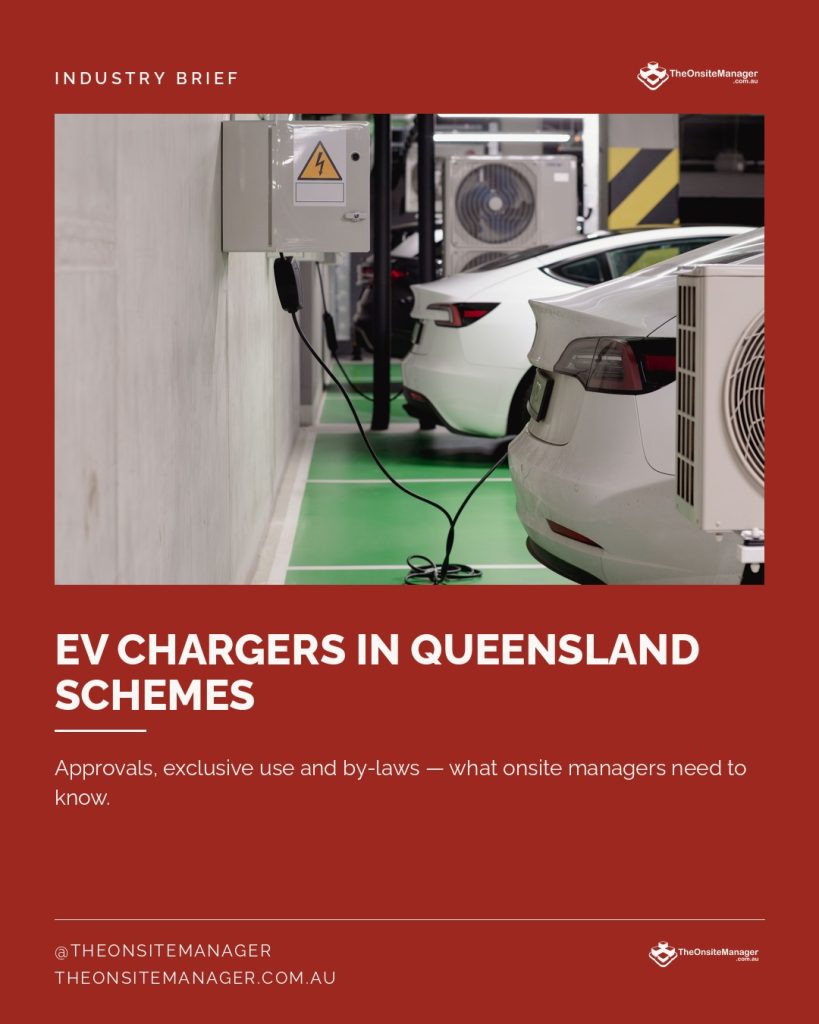
EV charger requests are now a regular part of onsite life in Queensland apartment and townhouse schemes. The State anticipates that 50% of new passenger vehicle sales will be zero-emission by 2030, and 100% by 2036. The BCCM Office fact sheet Electric vehicles in bodies corporate (updated 14 July 2026) is the practical starting point. Unlike our earlier Pavilion Bulimba interim-ruling note, this brief focuses on the approval path, exclusive use and by-laws.
A charger is usually an "improvement", not day-to-day maintenance. Even a unit inside a lot can still touch common property, because electrical wiring is often body-corporate "utility infrastructure". Check the community management statement for the regulation module — most permanent schemes use the Standard Module or the Accommodation Module — and whether the bay is part of the lot or exclusive use over common property.
Owner-installed chargers: committee or general meeting
Under Standard Module section 187 (Accommodation Module section 177), the body corporate may authorise an owner to improve common property for the benefit of that lot. A "minor improvement" has an installed value of $3,000 or less. The committee can approve it only if that threshold is met, the work does not detract from the appearance of any lot or common property, and the body corporate is satisfied the use is not likely to promote a breach of the owner's occupier duties (for example nuisance under BCCM Act section 167, or interference with utility supply under section 166). If any condition fails, an ordinary resolution at a general meeting is required. Conditions can be attached, and the owner must maintain the improvement unless excused. Once labour and electrical work are included, many installations will exceed $3,000.
An exclusive-use by-law does not automatically authorise a charger. If the by-law is silent on improvements, the owner still needs body corporate approval. The committee may approve an exclusive-use improvement costing $3,000 or less; above that, an ordinary resolution is required. Exclusive use also cannot be granted over common-property utility infrastructure.
Communal chargers, by-laws and metering
A body-corporate-funded communal charger is an improvement under Standard Module section 186 (Accommodation Module section 176). The basic improvements limit is $300 times the number of lots, and the committee also cannot exceed its spending limit ($200 times the number of lots, unless owners have increased it). It cannot approve an improvement over $300 times the number of lots, even if its ordinary spending limit is higher. Works above the basic limit, up to $2,000 times the number of lots, need an ordinary resolution — and only one such approval can be given in a financial year. Above $2,000 times the number of lots, a special resolution is required. If several works form one project, the total cost is what counts. Contact the building insurer first, and take advice from a licensed electrician and, where needed, a fire safety professional.
Fair use of a communal charger usually needs a by-law under section 169 — who may use it, when, and for how long. By-laws are limited by section 180: they must not be oppressive or unreasonable, and a by-law other than an exclusive-use by-law must not impose a monetary liability. Changing by-laws generally requires a special resolution and a new community management statement recorded at Titles Queensland. Watch visitor bays, parking by-laws and development approval conditions. A body corporate may supply electricity under a supply-of-services agreement with the user (Standard Module section 210; Accommodation Module section 200), typically recovering the actual cost of supply rather than writing a fee into a by-law. Keep section 96 in view: the body corporate must not carry on a business.
Practical takeaways for onsite managers
All electrical work must be carried out by a licensed electrician and comply with the AS/NZS 3000 Wiring Rules and the charger manufacturer's instructions. Onsite managers who join TheOnsiteManager operate as legally authorised agents of TheOnsiteManager, but they do not approve improvements, draft by-laws or sign off electrical work. Keep a paper trail of requests, quotes, insurer comments and conditions, and send complete motions to the committee or body corporate manager. Check whether the charger touches common property, exclusive use or only the lot, apply the $3,000 test including installation cost, and do not assume an exclusive-use bay already permits the work.
👉 Onsite managers: join TheOnsiteManager and operate as a legally authorised agent of TheOnsiteManager: https://www.theonsitemanager.com.au/join
Marketplace & industry hub: https://www.theonsitemanager.com.au
Sources: BCCM Office, Electric vehicles in bodies corporate (updated 14 July 2026, publications.qld.gov.au); qld.gov.au Improving common property and lots (7 January 2026) and Exclusive use by-law; BCCM Act 1997 (Qld) ss 94, 96, 100, 166, 167, 169, 180; Standard Module ss 186, 187, 210; Accommodation Module ss 176, 177, 200; AS/NZS 3000 Wiring Rules; Queensland Fire Department EV carpark position statement. Earlier brief: https://www.theonsitemanager.com.au/news/qld-ev-charger-bccm-interim-pavilion-bulimba/.
General information only, not legal advice. Your scheme's regulation module, community management statement, by-laws and facts will affect the outcome. Seek advice from a strata solicitor, your body corporate manager or the BCCM Office.
