
Shared Pool Safety Certificates: What Queensland Onsite Managers Need to Check Before Summer
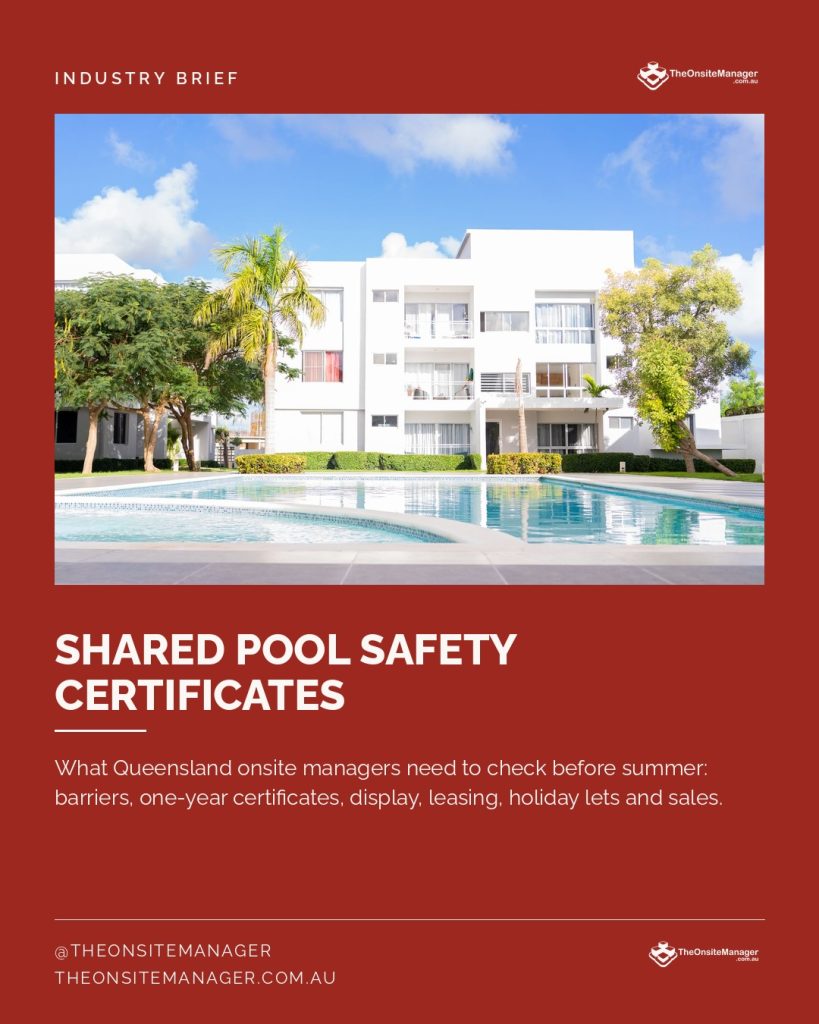
Summer is when the complex pool gets the most use, and when a propped-open gate or an expired certificate matters most. For onsite managers, the pool sits across both sides of the business: caretaking keeps it safe day to day, and letting can't run smoothly without the right paperwork. Here's what the Building Act 1975 (Qld) requires for shared pools in community titles schemes, and where the caretaker and letting agent fit in.
The body corporate owns the pool, and the barrier must comply at all times
For a pool on common property in a community titles scheme, the "owner" of the pool under the Building Act is the body corporate (Schedule 2). A pool is a shared pool when residents of two or more dwellings have a right to use it (s 231A). The owner must make sure the pool complies with the pool safety standard and that all barriers are kept in good condition (s 232), with a maximum penalty of 165 penalty units. The standard is Queensland Development Code part MP3.4, plus prescribed standards such as the resuscitation sign (s 231D). The QBCC notes a council can fine a pool owner for a non-compliant barrier even if a certificate is in place.
Certificates for shared pools last one year
A pool safety certificate (Form 23) for a shared pool expires one year after it is given, compared with two years for a non-shared pool (s 246AL). Only a QBCC-licensed pool safety inspector can issue one. The QBCC says all regulated pools must be on its pool register, and you can check online whether a current certificate is recorded. The register matters: for sales and leasing, a certificate is generally taken to be in effect if the register shows it, unless the owner knew or ought reasonably to have known it wasn't (s 246ATE).
Display it at the pool
While a certificate is in effect, the pool owner must conspicuously display a copy as near as practicable to the main entrance of the premises or a gate or door giving access to the pool (s 246ATH(2)).
Leasing a lot: copy or Form 36 before the agreement
Before entering an accommodation agreement for a lot, the lot owner must give the incoming occupier a copy of the current certificate (s 246ATH(4)). If no certificate is in effect, the owner must instead give a Notice of No Pool Safety Certificate (Form 36) before the agreement to the occupier, the body corporate and the QBCC (s 246ATI). The body corporate then has 90 days to get a certificate in effect (s 246ATK(4)). Letting agents usually handle this for owners, and the RTA's entry condition report (Form 1a) includes a check box for the tenant to confirm they received the certificate.
Holiday letting is treated differently
Where the shared pool is at a building providing short-term accommodation, such as a motel or hotel, the requirement to give the occupier a copy or a Form 36 doesn't apply (s 246ATH(3)–(4), s 246ATI(2)(a)). The display rule, the barrier rule, and the Form 36 to the body corporate and the QBCC still apply.
Sales: notices before settlement
A seller of a lot without a current certificate for a shared pool must give a Form 36 to the buyer, the body corporate and the QBCC before settlement (s 246ATF). The body corporate must then have a certificate in effect within 90 days after settlement (s 246ATK(2)).
Practical checklist for onsite managers
- Diarise the certificate's expiry and remind the committee well before the year is up.
- Check the register and the displayed copy match.
- Keep copies ready for every new lease, and use Form 36 when needed.
- Walk the barrier regularly: self-closing gates, latches, propped gates, and furniture or plants left near the fence.
- Report defects to the committee in writing, and keep a record.
The QBCC says that where a property has a manager, the manager is responsible for keeping the pool safe and making sure tenants and owners understand pool safety laws. Check what your caretaking agreement's duties say about pool inspections and repairs.
👉 Onsite managers: join TheOnsiteManager and operate as a legally authorised agent of TheOnsiteManager: https://www.theonsitemanager.com.au/join
Marketplace & industry hub: https://www.theonsitemanager.com.au
Sources: Building Act 1975 (Qld) ss 231A, 231D, 232, 246AL, 246ATE, 246ATF, 246ATH, 246ATI, 246ATK and Schedule 2 (legislation.qld.gov.au, current version); QBCC, "Buy, sell or lease a property with a pool" and "Guide to pool safety for homeowners" (qbcc.qld.gov.au); QBCC Form 36 Notice of no pool safety certificate; Residential Tenancies Authority, "Pool laws and maintenance" (rta.qld.gov.au).
General information only, not legal advice. Your scheme's by-laws, caretaking agreement and the pool's circumstances will affect what applies. Get advice from a lawyer, a licensed pool safety inspector or the QBCC before you act.
