
Rental Applications and Tenant Privacy in Queensland: What Onsite Managers Can Ask For, Keep and Must Destroy
By Tom from TheOnsiteManager.com.au
Since 1 May 2025, every permanent letting in a Queensland scheme has to run through a standard rental application process, with firm limits on what you can ask applicants, how you check their ID and how long you keep their details. For onsite managers running a letting pool, this is now a daily compliance task. Here's what the law says and how to get it right.
Use the approved form
If you require a prospective tenant to apply, you must use the required application form (Residential Tenancies and Rooming Accommodation Act 2008 (Qld) s 57B(3)). For general tenancies that's the RTA's Rental application (Form 22). The form can only ask for the applicant's name and contact details, previous tenancies, current employment, income, referees and the intended term (s 57B(4)), plus the extra items in s 4 of the Residential Tenancies and Rooming Accommodation Regulation 2025: date of birth, number of occupants and how many are under 18, pets (if the lessor approves pets), vehicles, and other evidence of ability to pay rent if the applicant can't give employment or income details. An online form is fine if it contains only that information.
Give at least two ways to apply
You must nominate at least two ways to submit an application, and at least one must not be a "restricted way" (s 57B(5)-(6)). Restricted ways include an online platform that passes the applicant's personal information to someone, other than the lessor, who collects it for the lessor and isn't a real estate agent, and any method that makes the applicant pay, such as a fee for a background check (Regulation s 5).
Supporting documents: two per category
Beyond the form, you may request no more than two documents in each of three categories: identity, financial ability to pay rent, and suitability for the tenancy (s 57C(1)).
What you must not ask
You can't request information about (s 57C(2)):
- legal action the applicant has taken, including dispute resolution or tribunal matters
- notices to remedy breach given to or by the applicant
- their rental bond history, including bond claims
- credit card or bank statements showing transactions
Checking ID
An applicant can give you a copy of an ID document, or let you sight the original. If you only sight it, you must not keep a copy without their consent (s 57D).
Collecting, storing and destroying personal information
You may collect an applicant's personal information only to assess their suitability, and a tenant's only if it relates to managing the agreement. Inspection photos count as management information (s 457D). Personal information includes photos of people's possessions or standard of living (s 457). It must be stored securely and accessed only for those purposes. Unsuccessful applicants' information must be securely destroyed within 3 months after the tenancy they applied for starts, unless they agree to a longer period. Tenants' information must be securely destroyed within 7 years after the agreement ends (s 457E). The RTA's guidance is that the 7-year rule applies to tenancies in place on or after 1 May 2025.
Tenancy databases
If you usually use a tenancy database to screen applicants, you must give each applicant written notice of the databases you use, why, and how to contact each operator, when the application is made (s 458A). It can go on the application form.
Penalties
Each of these requirements carries a maximum penalty of 20 penalty units. Holiday lets are outside the Act (s 31), so these rules apply to the permanent side of your letting pool.
A checklist for onsite managers
- Swap any old in-house application forms for Form 22 or a compliant online version.
- List two ways to apply on every listing, including one free option that doesn't require a third-party platform.
- Cap document requests at two per category and remove banned questions.
- Don't copy sighted ID without written consent.
- Lock down shared drives, inboxes and filing cabinets, and limit access.
- Set calendar reminders to destroy unsuccessful applications and old tenant files.
- Include your tenancy database notice on the form.
👉 Onsite managers: join TheOnsiteManager and operate as a legally authorised agent of TheOnsiteManager: https://www.theonsitemanager.com.au/join
Marketplace & industry hub: https://www.theonsitemanager.com.au
Sources: Residential Tenancies and Rooming Accommodation Act 2008 (Qld) ss 31, 57B-57D, 457-457E, 458A, 582 (legislation.qld.gov.au, current version); Residential Tenancies and Rooming Accommodation Regulation 2025 (Qld) ss 4-5; Residential Tenancies Authority, "Rental application (Form 22)" and "Personal information" (rta.qld.gov.au).
General information only, not legal advice. What applies depends on each lot and tenancy. Check with the Residential Tenancies Authority or a lawyer before you act.
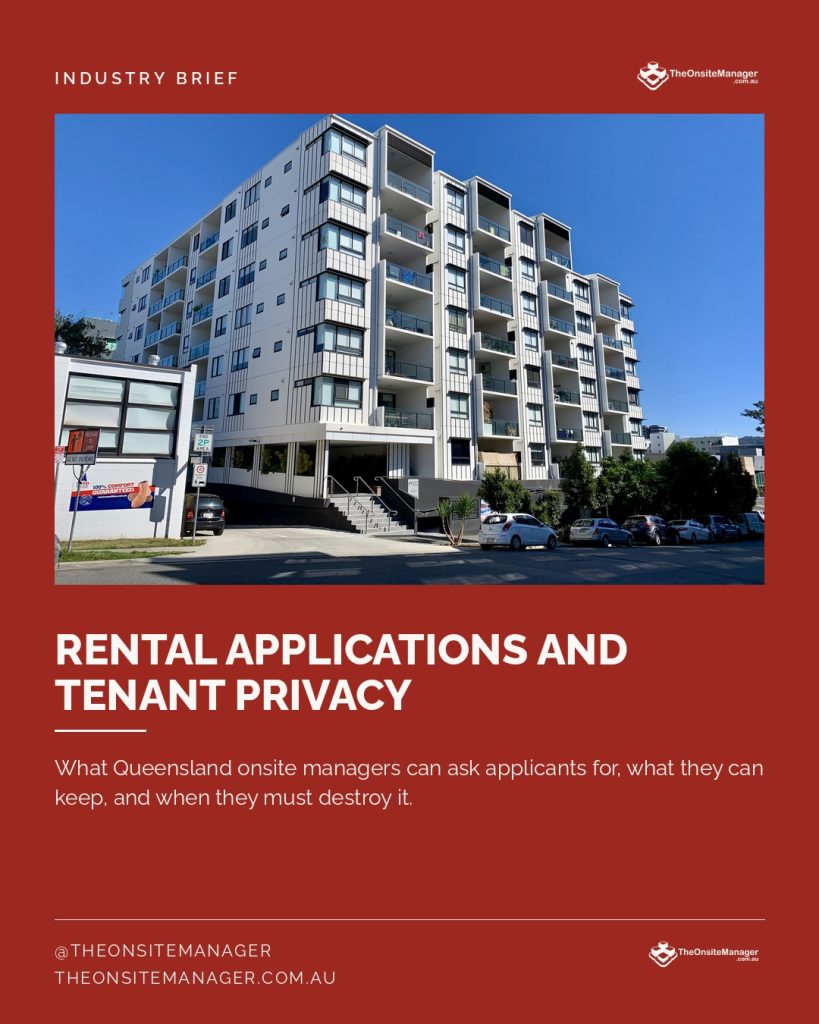
Photos via Wikimedia Commons: Apartment building in West End, Queensland by Kgbo (CC BY-SA 4.0); Legal Contract & Signature by Blogtrepreneur (CC BY 2.0); Aurora electronic calculator by Coyau (CC BY-SA 3.0); Australian passport by Evisa Express (CC BY 2.0); person holding smartphone by Shixart1985 (CC BY 2.0); Small paper shredder by Manuel Schmalstieg (CC BY 4.0); MacBook keyboard by Disk Depot Ltd. (CC BY-SA 4.0).
